Nara, Japan 3-day trip
Day 1
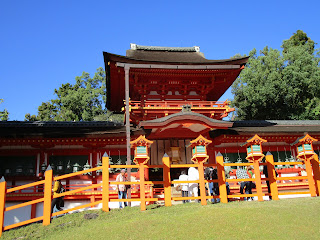
Before the year 710, Japan's capital would move to a new location each time there was a new emperor. It wasn't until 710 when Heijo, now known as Nara become the first permanent capital. Nara has some of Japan's oldest temples. On our first day there, we visited Kasuga Taisha.Kasuga Taisha was established at the same time Nara became the capital city. The building we walked through is not the original one as there was a custom to rebuild the shrine every 20 years. This custom has no longer been continued since the Edo Period. There are hundreds of lanterns hanging inside and they are all lit twice a year during two lantern festivals. There were many tourists locals alike visiting the shrine. There is an outer hall that is free to walk around and an inner area that you can walk through for 500 yen.

Day 2
The next day we visited Todai-ji, a Buddhist temple. Its Great Buddha hall has one of the world's largest bronze statue of Buddha. The temple's political power grew so great that eventually Japan's capital was moved to a different city in order to remove the temple's power on the government. In the temple, there is also a pillar with a hole. They say if you can squeeze through the hole you will be granted enlightenment in the next life.After visiting the temple we went to Isuien Garden, one of the gardens nearby. When we arrived we were greeted by two volunteers, one of which knew English, and they offered to do a tour for us. We enjoyed their tour and they even captured a picture of Blake and I once our tour ended.


Day 3
On our final day we visited Kofuku-ji Temple. The temple has been damaged, destroyed and rebuilt many times. Some of the buildings that were part of the temple were never rebuilt and only a few remain today.You're not allowed to take pictures of the inside, but there are various treasures you can see.These temples are within Nara park, a public park home to over 1,200 sika deer. The sika deer were considered sacred until World War II, when they were classified as national treasures instead. They are allowed to roam freely throughout the park. They even sell 鹿煎餅 (shika-senbei), a type of cracker, for 200 yen to feed to the deer. They bow to you before you feed them! Although they politely bow to be fed there are signs throughout the park reminding people that they are wild animals and should not be taunted as they can and sometimes do attack people.
 |
| Central Golden Hall - Kofuku-ji main temple hall |


Comments
Post a Comment